




Class: Cephalopoda. This box contains some remains of both Todarodes sagittatus and Loligo forbesii. It contains a beak, a dried specimen of suckers and skin as well as a long bone like item.
ID: Z555.1.181

Class: Bivalvia. 5 specimens. All specimens have both valves still attached.
ID: Z555.1.182

Class: Bivalvia. 5 specimens. Adults with the recognisable blue colouring. All specimens still have both valves joined. 2 have heavy barnacle epibionts of the species Chthamalus montagui.
ID: Z555.1.183

Class: Bivalvia. 3 specimens. All have both valves still connected. Large, subcircular and thick with well defined radiating growth lines. They vary in colour from whites to light purples and reds.
ID: Z555.1.184
Class: Bivalvia. 5 specimens. All have both valves still connected. Large, oval shaped and thick, these shells have clear concentric ridges and visible growth lines.
ID: Z555.1.185
Class: Bivalvia. 2 specimens, both with both valves still attached at the hinge. These specimens are very large, oval and thick. The periostracum is very dark brown.
ID: Z555.1.186
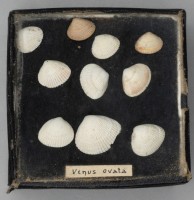
Class: Bivalvia. 10 specimens. 2 have both valves still attached and closed. 6 left valves and 2 right valves. Small, white, fan shaped with well defined ridges.
ID: Z555.1.187
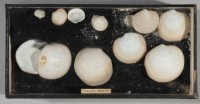
Class: Bivalvia. 12 specimens. 4 still have both valves attached, 4 right and 4 left valves, that were likely all connected to one another forming another 4 separate animals.
ID: Z555.1.188

Class: Bivalvia. 1 specimen. Very large and triangular with both valves present. The shell is very thin and fragile. Fan mussels are one of Britain's largest and rarest mussels.
ID: Z555.1.189
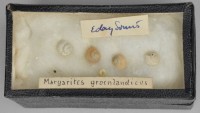
Class: Gastropoda. 5 specimens. Various shades of off white. Very small with 5-6 body whorls and spiral ridging. Found under stones, and on Laminaria seaweed holdfasts.
ID: Z555.1.19